Tips to Passing the TEAS Exam: Your Complete Study Guide for Success
If you’re planning to apply to nursing school, one of the biggest milestones you’ll face is the Test of Essential Academic Skills (TEAS) Exam. The TEAS exam is designed to evaluate whether you have the academic foundation needed to succeed in nursing school.
The good news? Thousands of students pass the TEAS every year—and with the right preparation, you can too.
In this guide, we’ll cover practical, proven tips that can help you improve your score and approach test day with confidence.
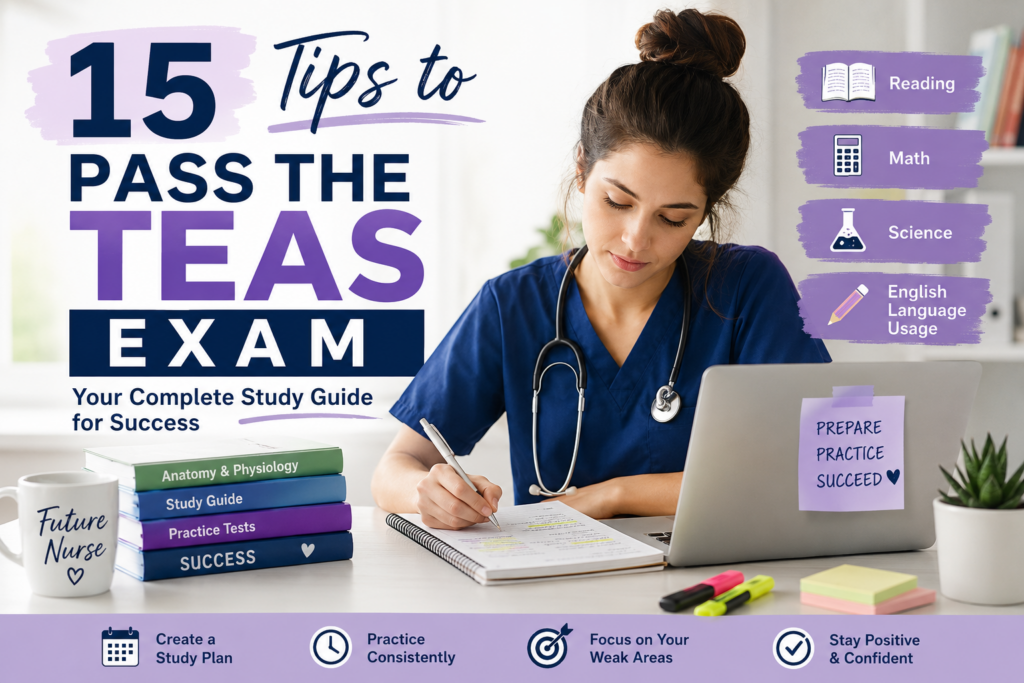
What Is the TEAS Exam?
The TEAS (Test of Essential Academic Skills) is an entrance exam used by many nursing and allied health programs throughout the United States. It evaluates your readiness for healthcare education by testing essential academic skills.
The exam covers four major subjects:
- Reading
- Mathematics
- Science
- English and Language Usage
Because nursing school is academically rigorous, schools use the TEAS exam to help determine whether applicants possess the foundational knowledge needed to succeed.
1. Start Studying Early
One of the biggest mistakes students make is waiting until the last minute.
Instead of trying to cram everything into one week, give yourself 6–8 weeks of consistent preparation.
A longer study schedule allows you to:
- Learn difficult concepts
- Improve weak subjects
- Retain information better
- Reduce test anxiety
Even studying 1–2 hours per day can make a significant difference over several weeks.
2. Learn the Format of the Exam
Many students lose points simply because they’re unfamiliar with how the exam is structured.
Understanding:
- Question styles
- Time limits
- Navigation
- Computer-based testing
helps reduce surprises on test day.
When you’re comfortable with the exam format, you can spend more time answering questions and less time figuring out how the test works.
3. Take a Practice Test First
Before you begin intensive studying, take a full-length practice exam.
This gives you a baseline score and shows you:
- Which subjects are strongest
- Which areas need improvement
- How well you manage time
- Which question types challenge you most
Your study plan should focus primarily on your weakest areas.
4. Create a Weekly Study Schedule
A study schedule helps you stay organized and prevents procrastination.
Example:
Monday
- Reading
Tuesday
- Science
Wednesday
- Math
Thursday
- English
Friday
- Practice Questions
Saturday
- Review Mistakes
Sunday
- Rest or Light Review
Consistency beats marathon study sessions.
5. Master Reading Comprehension
Many students underestimate the Reading section.
Practice:
- Identifying the main idea
- Drawing conclusions
- Making inferences
- Understanding the author’s purpose
- Distinguishing fact from opinion
Read carefully before selecting an answer.
6. Strengthen Your Math Skills
You don’t need advanced calculus, but you do need strong basic math skills.
Focus on:
- Fractions
- Decimals
- Percentages
- Ratios
- Proportions
- Algebra basics
- Measurement conversions
- Word problems
The more practice questions you complete, the faster you’ll become.
7. Spend Extra Time on Science
For many students, science is the most difficult section.
Review topics including:
- Human Anatomy & Physiology
- Biology
- Chemistry
- Scientific reasoning
- Scientific method
Rather than memorizing isolated facts, focus on understanding how body systems work together.
8. Review English and Grammar
This section tests communication skills that every future nurse needs.
Study:
- Grammar
- Sentence structure
- Punctuation
- Capitalization
- Spelling
- Vocabulary
- Context clues
Even small improvements here can boost your overall score.
9. Practice Answering Questions Under Time Limits
Knowing the material is only part of passing the TEAS.
You also need to manage your time effectively.
During practice:
- Use a timer
- Avoid spending too long on one question
- Move on if you’re stuck
- Return later if time allows
Time management is a skill that improves with practice.
10. Review Every Mistake
Don’t just check whether your answer was wrong.
Ask yourself:
- Why was it wrong?
- What concept did I misunderstand?
- How can I avoid making this mistake again?
Your incorrect answers are some of your best learning opportunities.
11. Use Flashcards
Flashcards help reinforce memory through repetition.
Create cards for:
- Medical terminology
- Anatomy
- Scientific vocabulary
- Math formulas
- Grammar rules
Review them for 10–15 minutes every day.
12. Study a Little Every Day
Studying consistently is much more effective than cramming.
Research has shown that spaced repetition helps move information into long-term memory.
Aim for daily review instead of occasional marathon sessions.
13. Eliminate Distractions
Create a study environment that allows you to focus.
Turn off:
- Social media notifications
- Television
- Unnecessary phone alerts
Studying with fewer distractions improves concentration and retention.
14. Take Care of Yourself
Your brain performs best when your body is healthy.
Remember to:
- Sleep 7–9 hours each night
- Stay hydrated
- Eat balanced meals
- Exercise regularly
- Take short study breaks
Self-care is part of your study strategy.
15. Stay Positive
Many students convince themselves they’ll fail before they even take the exam.
Instead:
- Celebrate small improvements
- Focus on progress, not perfection
- Remember that preparation builds confidence
A positive mindset can help reduce test-day anxiety.
Common Mistakes to Avoid
Avoid these common pitfalls:
- Waiting until the last minute to study
- Ignoring your weakest subjects
- Skipping practice tests
- Memorizing without understanding
- Not reviewing incorrect answers
- Studying for hours without taking breaks
- Arriving late on test day
- Staying up all night before the exam
What to Do the Night Before the TEAS Exam
The night before your exam:
- Pack everything you’ll need
- Review only light material
- Avoid trying to learn new concepts
- Get plenty of sleep
- Set multiple alarms
- Eat a healthy dinner
- Relax before bed
A well-rested mind performs much better than an exhausted one.
Test Day Tips
On exam day:
- Arrive early
- Eat a healthy breakfast
- Stay calm
- Read every question carefully
- Eliminate obviously incorrect answers
- Watch your time
- Don’t panic if you encounter a difficult question
Remember, one difficult question doesn’t determine your overall score.
Prepare Smarter with Choosing Nursing Plus
Preparing for the TEAS exam doesn’t have to feel overwhelming. Having structured lessons, practice questions, and clear explanations can make studying more efficient and less stressful.
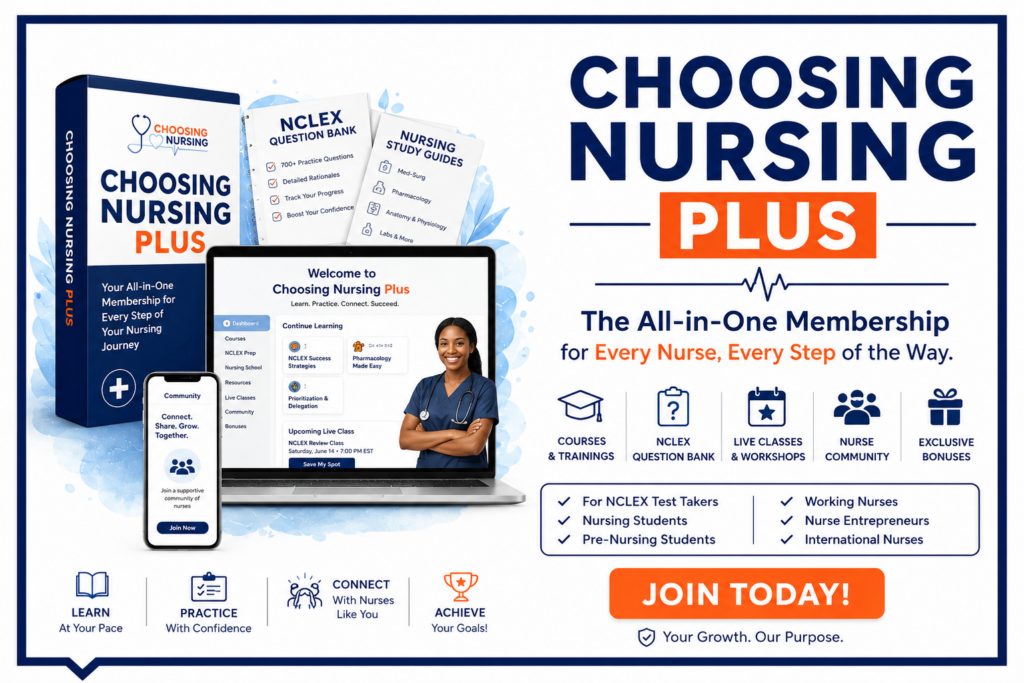
Inside Choosing Nursing Plus, you’ll gain access to resources designed to help future nursing students build confidence before nursing school, including:
- TEAS preparation materials
- Anatomy & Physiology lessons
- Practice quizzes
- Video lessons
- Nursing study resources
- Educational community support
- Additional nursing school success resources
Whether you’re just beginning your nursing journey or preparing to submit your application, consistent preparation can help you perform at your best on exam day.
Final Thoughts
Passing the TEAS exam isn’t about being naturally gifted—it’s about preparation, consistency, and using effective study strategies.
Start early, practice often, focus on your weak areas, and learn from every mistake. Every study session brings you one step closer to your goal of getting accepted into nursing school.
Believe in yourself, trust the work you’ve put in, and remember that this exam is just one milestone on your path toward becoming a nurse.
Recommended Reading
- How to Register for the NCLEX Step-by-Step in 2026 https://choosingnursing.net/how-to-register-for-the-nclex-step-by-step-in-2026/
- NCLEX Prioritization and Delegation Made Easy: How to Answer These Questions with Confidence https://choosingnursing.net/nclex-prioritization-and-delegation/
- 2026 NCLEX Updates Every Nursing Candidate Needs to Know https://choosingnursing.net/2026-nclex-updates/
- How To Pass The Nclex After Failing (Without Feeling Overwhelmed) https://choosingnursing.net/how-to-pass-the-nclex-after-failing/
- Good Pop-Up vs Bad Pop-Up After the NCLEX https://choosingnursing.net/good-pop-up-vs-bad-pop-up-nclex/
- How To Find U.S. Nurse Visa Sponsorship Jobs in 2026 (Complete Guide) https://choosingnursing.net/us-nurse-visa-sponsorship-jobs/
Recommended Study Resource
- 70 Diseases Book (Physical) https://www.amazon.com/dp/B0GJPGSL33
- 70 Diseases Book (Digital) https://choosingnursingstore.com/products/the-70-diseases-and-conditions-nclex-cheat-sheet
- 30 Days NCLEX Bootcamp https://choosingnursingstore.com/products/30-days-nclex-bootcamp
- Cheat Sheet Bundle https://choosingnursingstore.com/products/the-ultimate-cheat-sheet-bundle