If hearing the words “ECG interpretation” makes your heart skip a beat (pun intended), you’re not alone. For so many nursing students, ECGs (also called EKGs) feel overwhelming.
All those squiggly lines, waveforms, and rhythms can seem like a foreign language. But here’s the truth: once you learn the basics, reading ECGs for the NCLEX becomes a whole lot easier!
So, grab your stethoscope, take a deep breath, and let me walk you through exactly how to interpret ECGs step-by-step for your NCLEX exam and clinical practice.
Click here to download our free Understanding ECGs guide!
⭐️ What is an ECG (EKG) Anyway?
An ECG (electrocardiogram) is a test that records the electrical activity of the heart.
For the NCLEX, you don’t need to become a cardiologist, but you do need to know how to recognize life-threatening rhythms and understand the basics of what’s normal vs. what’s dangerous.
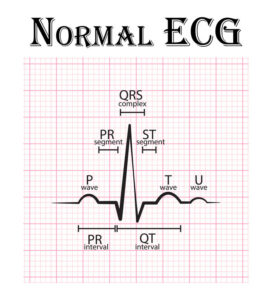
⭐️ The Key Parts of an ECG Strip
Let’s break down the main parts of a typical ECG strip:
-
P Wave – Represents atrial depolarization (when the atria contract).
-
PR Interval – The time it takes for the electrical signal to travel from the atria to the ventricles.
-
QRS Complex – Represents ventricular depolarization (when the ventricles contract).
-
T Wave – Represents ventricular repolarization (when the ventricles reset to start the cycle over).
💡 Quick tip: 👉 P = Atria 👉 QRS = Ventricles 👉 T = Reset
⭐️ How to Read an ECG in 5 Easy Steps
Here’s the simple, repeatable system I teach my students for quickly interpreting any ECG strip:
1️⃣ What’s the rate?
-
Normal heart rate is 60-100 bpm.
-
Use the “6-second rule” (count the number of QRS complexes in a 6-second strip and multiply by 10).
2️⃣ Is the rhythm regular or irregular?
-
Are the R-R intervals (the space between the tall QRS spikes) equal?
3️⃣ Is there a P wave before every QRS?
-
If yes, the atria are doing their job!
4️⃣ Measure the PR interval.
-
Normal PR interval = 0.12–0.20 seconds (3-5 small boxes).
5️⃣ Measure the QRS complex.
-
Normal QRS duration = 0.06–0.12 seconds (1.5-3 small boxes).
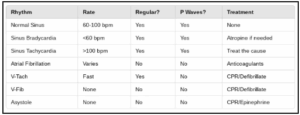
⭐️ Common NCLEX ECG Rhythms You MUST Know
✅ Normal Sinus Rhythm
-
Rate: 60-100 bpm
-
Regular rhythm
-
P wave before every QRS
-
PR and QRS intervals normal
💡 This is what we want to see!
❌ Sinus Bradycardia
-
Rate: <60 bpm
-
Regular rhythm
-
Everything else looks normal, just slow
💡 NCLEX Tip: Watch for symptoms like dizziness, fatigue, or hypotension. Treatment might include atropine or a pacemaker if symptomatic.
❌ Sinus Tachycardia
-
Rate: >100 bpm
-
Regular rhythm
-
P wave before every QRS
-
PR and QRS intervals normal
💡 NCLEX Tip: Treat the cause—could be fever, pain, dehydration, anxiety, etc.
❌ Atrial Fibrillation (A-Fib)
-
Irregularly irregular rhythm
-
No distinct P waves
-
Can have a normal or rapid rate
💡 NCLEX Tip: Watch for clots! Patients are usually on anticoagulants like warfarin.
❌ Ventricular Tachycardia (V-Tach)
-
Fast rate, often 150-250 bpm
-
Wide QRS complexes
-
No P waves
💡 NCLEX Tip:
-
With a pulse: Cardioversion.
-
Without a pulse: Start CPR and defibrillation immediately.
❌ Ventricular Fibrillation (V-Fib)
-
No identifiable waves
-
Chaotic, irregular electrical activity
-
NO pulse
💡 NCLEX Tip: This is an emergency! Start CPR and defibrillation ASAP.
❌ Asystole
-
Flatline
-
No electrical activity
💡 NCLEX Tip: No shocking here. Start CPR and give epinephrine.
⭐️ Final NCLEX Tips for ECG Interpretation:
✅ Memorize the life-threatening rhythms first: V-Tach, V-Fib, Asystole.
✅ Know when to shock and when to do CPR.
✅ Recognize normal vs. abnormal rhythms by focusing on rate, rhythm, P waves, and QRS.
✅ Practice, practice, practice reading strips!
🚀 Want More Help with ECGs?
Download our Free ECG Interpretation Guide or enroll into our Success To EKGs Course where I break down more ECG strips, practice questions, and test-taking strategies that actually work.
And hey, if this post saved your life today, share it with a friend who’s struggling with ECGs too. We nurses have to stick together. 💜
Recommended Reading
- NCLEX Prioritization and Delegation Made Easy: How to Answer These Questions with Confidence https://choosingnursing.net/nclex-prioritization-and-delegation/
- 2026 NCLEX Updates Every Nursing Candidate Needs to Know https://choosingnursing.net/2026-nclex-updates/
- How To Pass The Nclex After Failing (Without Feeling Overwhelmed) https://choosingnursing.net/how-to-pass-the-nclex-after-failing/
Good Pop-Up vs Bad Pop-Up After the NCLEX https://choosingnursing.net/good-pop-up-vs-bad-pop-up-nclex/