CNA Charged After Patient Dies Following Hoyer Lift Fall: What Healthcare Workers Should Know
Disclosure: This post may contain affiliate links, sponsored content, or paid partnerships. Choosing Nursing may receive compensation if you click certain links or make a purchase, at no additional cost to you. Please see our Disclosure Policy for more information.
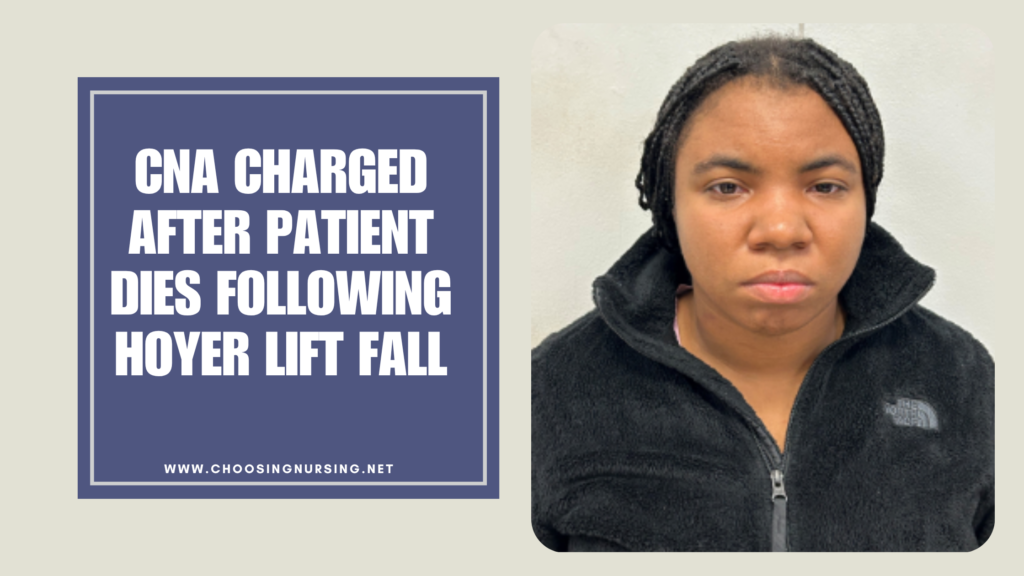
A former certified nursing assistant in Louisiana was indicted on a negligent homicide charge after a nursing home resident died following a fall from a patient lift.
The case is an important reminder for CNAs, nurses and nursing students about just how serious patient-transfer procedures can be—and why something that may feel like a routine task should never become a shortcut.
According to the Louisiana Attorney General’s Office, Diamond Johnson was working as a CNA at Jefferson Manor in Baton Rouge when the incident occurred on June 14, 2024.
Authorities say Johnson was using a hydraulic patient lift to transfer a resident from a chair to her bed.
She was operating the lift by herself.
During the transfer, the patient reportedly slipped out of the side of the sling and fell onto the feet/base area of the lift.
Approximately 40 minutes later, the resident became unresponsive. Resuscitation efforts were unsuccessful.
An autopsy later determined that the resident died from complications of blunt-force injuries sustained in the fall.
On October 2, 2025, a grand jury indicted Johnson on a charge of negligent homicide.

It is important to remember that an indictment is a criminal accusation, not a conviction. Johnson is entitled to the presumption of innocence unless and until proven guilty.
Related Reading
- North Carolina Nurses Hit With $25-an-Hour Pay Cut for Working Weekends
- The Radonda Vaught Case Update
- The Nurse Practitioner
Why This Case Matters to Nurses and CNAs
Mechanical lifts are common in nursing homes, rehabilitation centers, hospitals and home-care environments.
They’re designed to make patient transfers safer while reducing injuries to both patients and healthcare workers.
But a mechanical lift is still medical equipment.
When the wrong sling is used, straps aren’t properly attached, equipment isn’t inspected, a patient’s care plan isn’t followed, or a transfer is attempted without the assistance required for that patient, a routine transfer can become dangerous.
The U.S. Food and Drug Administration warns that improper use of patient lifts has resulted in serious injuries, including fractures, head trauma and deaths.
This case therefore provides an important opportunity to review some basic principles of safe mechanical-lift use.
What Is a Hoyer Lift?
“Hoyer lift” is commonly used to describe a type of mechanical patient lift.
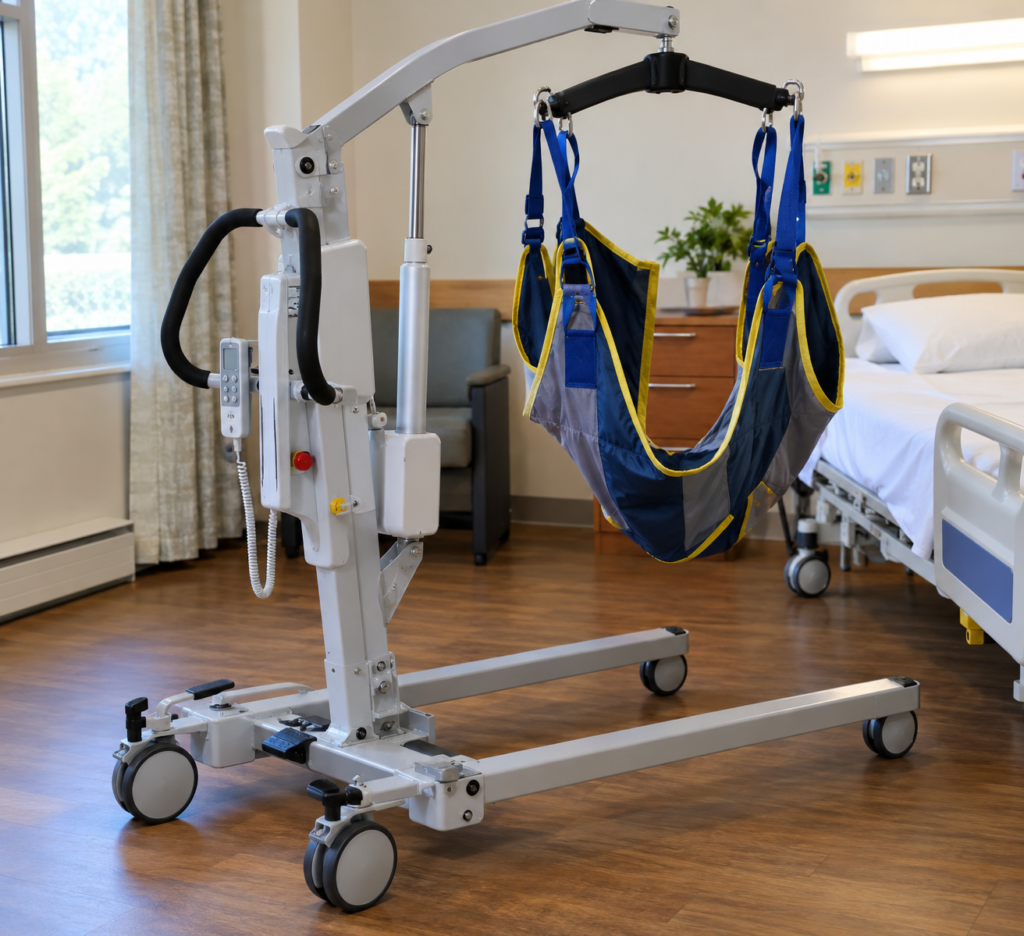
The device typically uses a sling positioned underneath the patient. The sling attaches to the lift, allowing a caregiver to raise and transfer someone who cannot safely stand, pivot or transfer independently.
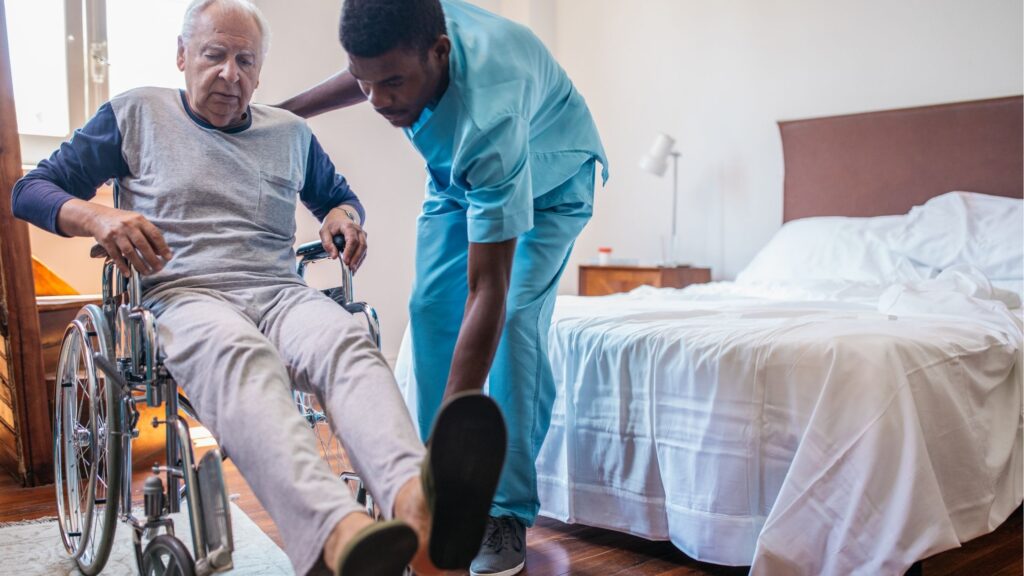
Mechanical lifts may be used for transfers such as:
- Bed to wheelchair
- Wheelchair to bed
- Bed to chair
- Chair to another appropriate surface
The exact procedure depends on the patient’s condition, the specific lift and sling being used, the patient’s individualized care plan and facility policies.
How to Use a Hoyer Lift More Safely
There is an important rule before discussing individual steps:
Never assume that every Hoyer lift, sling or patient transfer works the same way.
Healthcare workers should follow the manufacturer’s instructions for the specific lift and sling, the patient’s care plan, facility policy and their training.
With that in mind, the FDA identifies several important patient-lift safety practices.
1. Know the Patient’s Transfer Requirements
Before beginning a transfer, review the patient’s current care plan and transfer requirements.
Does the patient require a mechanical lift?
What type of sling is required?
Does the patient’s care plan require two staff members?
Can the patient participate in the transfer?
Has the patient’s mobility or condition changed?
A caregiver should not independently change a patient’s established transfer plan simply because a different method appears faster or easier.
If the care plan requires two-person assistance, wait for the second trained staff member.
2. Make Sure You’re Trained on the Equipment
Staff members should receive appropriate training before operating a patient lift.
Knowing how one mechanical lift works does not necessarily mean every lift operates identically.
Healthcare workers should know how to operate the particular equipment available in their facility and understand its safety features.
If you’re unfamiliar with the equipment, ask for assistance before attempting the transfer.
3. Use the Correct Sling
The sling is one of the most important parts of the transfer.
According to the FDA, the sling should be compatible with the specific patient lift and appropriate for the patient’s weight.
Not every sling works with every lift.
The patient’s size, physical condition and transfer needs should also be considered when selecting the appropriate sling.
4. Inspect the Sling Before the Transfer
Before lifting the patient, inspect the sling and its straps.
Look for:
- Tears
- Fraying
- Damaged stitching
- Stretched material
- Worn straps
- Damaged attachment points
- Other visible signs of deterioration
If a sling appears damaged, do not use it.
A damaged sling can fail while the patient is suspended.
5. Check Every Attachment Before Raising the Patient
One of the most important moments occurs before the patient leaves the supporting surface.
Confirm that the sling’s straps, loops, clips or other attachments are correctly positioned and securely connected to the lift according to the manufacturer’s instructions.
The FDA specifically recommends ensuring that clips, latches and hanger bars remain securely fastened during operation.
Don’t rely on a quick visual glance.
Follow the equipment’s required safety check.

6. Follow the Lift’s Weight Limits
Every lift and sling has weight limitations.
Never exceed them.
The lift itself may have one capacity while the sling has another.
Healthcare workers should verify the limits of both components.
7. Position the Lift Correctly
The FDA recommends positioning the base legs of applicable patient lifts in their maximum open position during lifting to provide stability.
Follow the manufacturer’s instructions for the particular device being used.
The receiving surface also needs to be prepared before beginning the transfer.
For example, when transferring someone into a wheelchair, the wheelchair should be properly positioned and secured according to facility policy and equipment instructions.
8. Don’t Ignore Changes in the Patient
A transfer that was appropriate yesterday may not necessarily be appropriate today.
Pay attention to changes such as:
- New weakness
- Pain
- Confusion
- Agitation
- Decreased ability to follow commands
- Changes in mobility
- Changes in weight-bearing ability
- New injuries or procedures
The FDA specifically advises ensuring that a patient is not restless or agitated during a lift transfer.
If something about the patient’s condition makes the planned transfer appear unsafe, stop and notify the appropriate nurse or supervisor rather than improvising.
9. Follow Two-Person-Assist Requirements
This is particularly relevant to the Louisiana case.
Authorities specifically emphasized that Johnson allegedly operated the hydraulic lift by herself.
However, it would be inaccurate to say that every mechanical lift universally requires two healthcare workers in every situation.
Some manufacturers permit certain equipment to be operated by one appropriately trained caregiver under specific circumstances.
What matters is the patient’s care plan, facility policy, clinical assessment, manufacturer instructions and the specific equipment being used.
If any of those require two trained staff members, don’t perform the transfer alone.
There are documented cases in which facilities have been cited after staff ignored established two-person mechanical-lift requirements.
Being short-staffed or in a hurry doesn’t make an unsafe transfer safe.

10. Stop If Something Doesn’t Look Right
One of the most important patient-safety skills isn’t memorizing a procedure.
It’s recognizing when to stop.
If the sling appears incorrectly positioned, an attachment doesn’t look secure, the patient begins slipping, equipment appears damaged, or something simply isn’t proceeding as expected, don’t continue the transfer just to finish it.
Follow your training and facility’s emergency procedures and get appropriate assistance.
A Hoyer Lift Should Protect the Patient—Not Put Them at Risk
Mechanical patient lifts exist for an important reason.
They can protect healthcare workers from musculoskeletal injuries while allowing patients with significant mobility limitations to be transferred more safely and with dignity.
But equipment doesn’t eliminate the need for clinical judgment, training or adherence to safety procedures.
The Louisiana case demonstrates just how serious the consequences of a patient-transfer incident can become.
A resident lost her life.
A former CNA is now facing a criminal charge.
And the incident that led to both outcomes occurred during something healthcare workers perform every day: a patient transfer.
There Is Also a Larger Conversation About Staffing
Cases like this can understandably generate discussion among CNAs and nurses about staffing.
Healthcare workers may sometimes feel pressure to complete care quickly when help isn’t immediately available.
But patient safety procedures cannot simply disappear because a unit is busy.
If a patient’s care plan or facility policy requires additional staff for a transfer and appropriate help isn’t available, the safer response is to escalate the situation through the appropriate chain of command rather than knowingly performing a transfer that doesn’t meet the patient’s established safety requirements.
Healthcare organizations also have a responsibility to provide adequate training, appropriate equipment, equipment maintenance and systems that allow staff to follow established safety procedures.
Patient safety is not solely about individual workers—it also depends on the systems in which they are expected to provide care.
For Nursing Students: This Is Why Fundamentals Matter
If you’re currently in nursing school or preparing for the NCLEX, stories like this show why seemingly simple nursing fundamentals matter so much.
Patient positioning.
Fall precautions.
Assistive devices.
Delegation.
Safety.
Mobility.
Transfer techniques.
Knowing when to ask for help.
These aren’t just questions you memorize to pass an exam.
They become decisions you make when another person’s safety is in your hands.
And the NCLEX frequently tests nursing candidates on a similar principle:
What is the safest action for the patient?
Understanding patient safety, prioritization, delegation and fundamental nursing care can help you both on the NCLEX and when you eventually practice at the bedside.
Preparing for the NCLEX-RN?
If you’re preparing for the NCLEX-RN or you’re a repeat test taker, the Choosing Nursing NCLEX Blueprint Review Program was designed to help you strengthen the content, prioritization and test-taking skills you need to approach NCLEX questions more confidently.
Instead of simply memorizing more information, focus on understanding how to recognize what the question is asking, identify the biggest patient-safety concern and choose the safest nursing intervention.
Learn more about the Choosing Nursing NCLEX Blueprint Review Program.
Preparing for the NCLEX-PN?
We also have a dedicated Choosing Nursing NCLEX-PN Review Program for practical nursing candidates preparing for the NCLEX-PN.
The program helps reinforce important nursing concepts while preparing you to work through NCLEX-style questions and make safe patient-care decisions.
Learn more about the Choosing Nursing NCLEX-PN Review Program.
Final Thoughts
The death of a patient during a mechanical-lift transfer is a devastating outcome for everyone involved.
As the criminal case involving Diamond Johnson continues, the allegations should not be treated as a final determination of guilt.
But healthcare professionals can still learn an important lesson from what reportedly occurred.
Never allow a routine task to become so routine that you stop respecting the risks involved.
Check the care plan.
Know the equipment.
Inspect the sling.
Verify the attachments.
Use the required number of trained staff.
And when something isn’t safe—stop.
Sometimes the most important thing a healthcare worker can do for a patient is simply refuse to take an unnecessary risk.
Sources
U.S. Food and Drug Administration — Patient Lifts
WAFB/FOX 8 — reporting on the Diamond Johnson indictment
Disclaimer: This article is for educational and informational purposes and does not replace your employer’s policies, a patient’s individualized care plan, manufacturer instructions, professional training, or clinical judgment. Criminal charges are allegations unless and until proven in court.

Additional Reading
- How to Turn Your NCLEX Knowledge Into a Six-Figure Business https://choosingnursing.net/how-to-turn-your-nclex-knowledge-into-a-six-figure-business/
- I’ve Applied to Over 100 Nursing Jobs Places and Nothing! Now What? https://choosingnursing.net/applied-to-over-100-nursing-jobs/
- Which Specialty Should I Choose? https://choosingnursing.net/which-specialty-should-i-choose/
- How to Use the STAR Method to Ace Any Nursing Interview (With Examples) https://choosingnursing.net/how-to-use-the-star-method/
- Black ICU Nurse Wins $20 Million Lawsuit Against Hospital https://choosingnursing.net/black-icu-nurse-20-million-lawsuit-verdict/
- Barabanki YouTube Surgery Case: Woman Dies After Fake Doctor Attempts Surgery Using YouTube Tutorial https://choosingnursing.net/barabanki-youtube-surgery-medical-negligence-case/
- Top 10 States Where Nurses Earn the Most After Cost of Living (2026) https://choosingnursing.net/nurses-pay-adjusted-for-cost-of-living/
- Nurse Salary by State 2026: Top Paying Locations https://choosingnursing.net/nurse-salary-by-state-206-top-paying/